
What Could Ever Go Wrong?
Until July 31, 2026, the name Leopold Aschenbrenner was mainly known inside elite financial circles. But his notoriety was growing rapidly.
His hedge fund, Situational Awareness, had jumped on the Artificial Intelligence train with a strategy of exploiting companies thought to benefit from AI while simultaneously betting against companies that would be destroyed by AI.
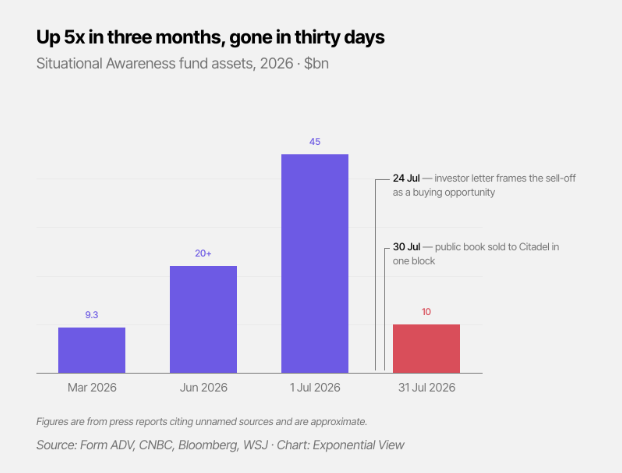
Seemingly, Aschenbrenner could do no wrong. In March 2026, the fund was managing $9.3 billion leaping to $20 billion in June and then more than doubling to $45 billion by July 1st. This was a 5x return in three months.
However, over the next thirty days, the fund gave up all gains, plummeting to $10 billion by July 31st. Worse yet, the only remaining assets held by Situational Awareness were illiquid ones. As such, the true stability and value of the fund remains in question. Currently, the fund is estimated to have $7 billion of illiquid AI equity bets.
This should prompt many questions.
Who is Aschenbrenner? Often described as a “wunderkind,” he entered Columbia University at age 15, graduating as valedictorian in 2020 at age 19. After writing a manifesto outlining how Artificial General Intelligence would produce super intelligence by 2027, several in the tech arena decided to back the young genius.
What happens next to Situational Awareness is anyone’s guess.
Aschenbrenner is a mere 24 years old and has never run an investment fund before. As such, he was completely untested. He had not managed money through the Dot.com bust, the Great Financial Crisis or the Pandemic. He had academic theories, but that is it. You never know how good an investment strategy or manager might be until they are repeatedly tested. Many financial strategies sound great in an academic laboratory until the realities of the world pull them apart.
How did his fund catapult from $9 billion to $45 billion in four months? During that time frame, there was no single, or group of, investments that would have produced that return, unless massive leverage was used. Aschenbrenner not only used a bit of leverage, his fund was juiced by 400% borrowed money.
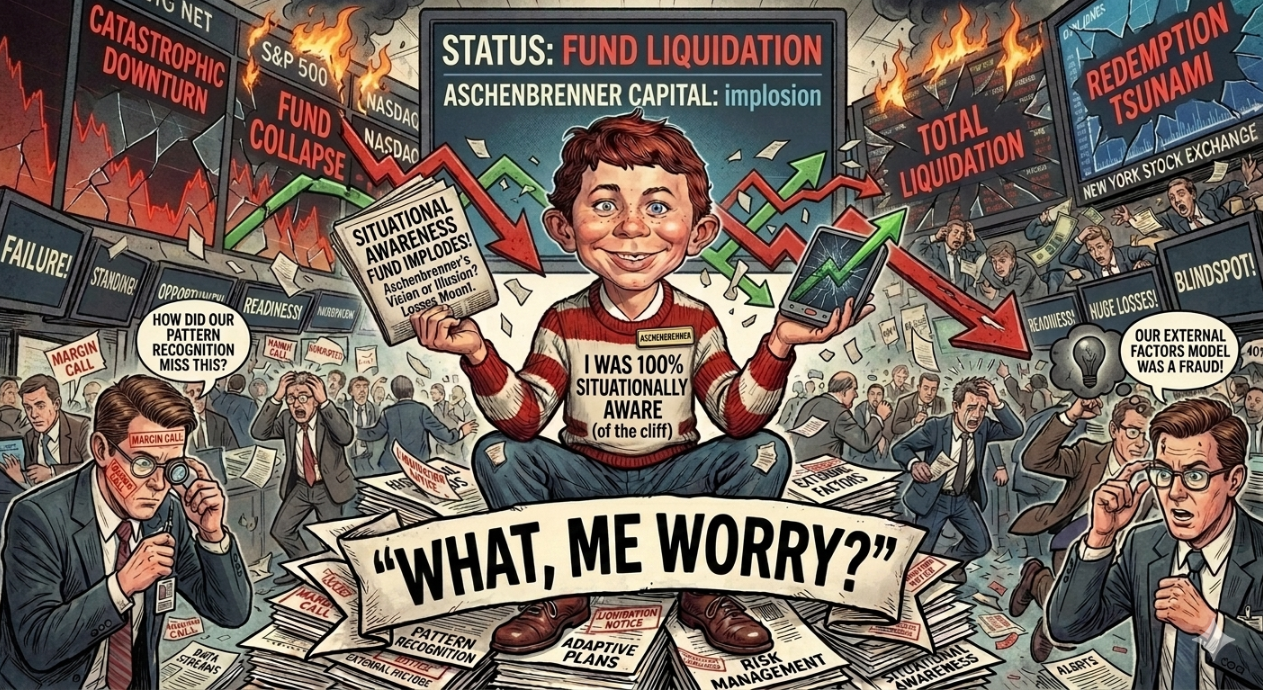
Not only did Aschenbrenner use leverage to bet on companies he thought would go up, but he also borrowed funds to bet on companies he thought would decline. While this strategy worked, he looked like a genius.
However, the second his bets started to back-fire, his house of leverage rapidly collapsed. Seizing upon Aschenbrenner’s weakened position, Wall Street sharks took him to his knees, forcing him to sell all his publicly traded securities.
Just as freely as some of the largest Wall Street brokers had lent money to Situational Awareness, they were even quicker to force margin call liquidations. Wall Street is not your friend.
Making matters worse, Situational Awareness had taken very concentrated bets mostly in the same industry. Not only was he using leverage, but his portfolio lacked basic diversification. As such, when forced to liquidate, it became a stampede through a self-imposed bottleneck.
What can be learned from this?
The barriers to entry on Wall Street can be quite low. However, that does not mean you have the experience necessary to successfully navigate stormy weather. There is no substitute for experience.
Aschenbrenner assumed his vision for AI would play out by 2027. He may eventually be right. However, trying to make very specific industry or macro-economic calls can be catastrophic, especially within tightly defined timeframes. Give yourself enough time to succeed.
Leverage is incredibly seductive. When it goes your way, it encourages additional leverage. Wall Street will be there to offer borrowed money…right up to the point that it wipes you out.
Wise and tenured investors spend most of their time trying to figure out what can go wrong. And then they avoid anything that could remotely expose them to a collapse. No one cares how good you were once, if you ultimately blow up.
Successful investing is far more about temperament and knowing what can go wrong. When things are going right, it is very difficult to step away from the punch bowl. In Aschenbrenner’s case, he just kept piling on leverage with the assumption that he was right.
Warren Buffett has repeatedly said that if an investor has a 160 IQ, they should give back 30 points. The game of investing is not about genius smarts. Rather, it is about discipline, rationality, emotional stability and temperament.
Dave Sather is a Certified Financial Planner and the CEO of the Sather Financial Group, a fee-only investment management and strategic planning firm.
